


> COLLECTION > AIRCRAFT > SHORTS > Short SB.5 jet

Short SB.5 Jet

Image: MARK J. CAIRNS
The aircraft that helped shape the Lightning
The Short SB.5 was an extraordinary Belfast-built research aircraft, created to answer a vital question in the early jet age: what was the best layout for Britain’s next supersonic fighter?
Built by Short Brothers & Harland, WG768 was designed to test the low-speed handling of highly swept wings and alternative tailplane arrangements.
Its findings helped confirm the configuration selected for the English Electric P.1 — the aircraft which became the legendary English Electric Lightning.
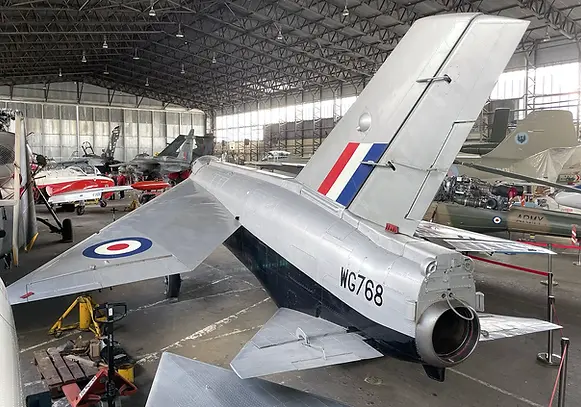
Image: MARK J. CAIRNS
An adjustable research aircraft
The SB.5 was not a prototype Lightning. It was a purpose-built flying testbed, deliberately engineered to be altered between test programmes.
Its wings could be reset on the ground to sweep angles of 50°, 60° or 69°. At 69°, it had the greatest wing sweep of any aircraft then flying.
The complete rear fuselage could also be changed. One arrangement carried the tailplane low on the rear fuselage; the other placed it high on the fin, creating a distinctive T-tail.

Image: MARK J. CAIRNS
Testing the extremes
WG768 first flew from Boscombe Down on 2 December 1952, piloted by Shorts Chief Test Pilot Tom Brooke-Smith.
Initial flying was carried out with 50° wing sweep. The aircraft was later reconfigured with 60° and, finally, 69° sweep.
The original Rolls-Royce Derwent engine was eventually replaced by a more powerful Bristol Orpheus. A Martin-Baker ejection seat was also fitted before the final phase of testing.

Image: MARK J. CAIRNS
The high T-Tail returns
The high T-tail arrangement was tested extensively, but proved unsatisfactory.
The SB.5’s trials instead confirmed the advantages of a low-mounted tailplane combined with a 60° swept wing — the arrangement adopted for the P.1 and its production successor, the Lightning.
This unusual little aircraft therefore played an important part in the development of one of Britain’s most dramatic Cold War fighters.
The UAS is delighted to have secured the SB.5’s alternative high T-tail rear fuselage as well as the aircraft itself.
Together, they show exactly how Shorts engineers created one aircraft capable of testing two radically different tail arrangements.
Empire Test Pilots' School and move to UAS
Following its research career, WG768 served with the Empire Test Pilots’ School at Farnborough by 1967, giving students experience of flight-testing a "slender", highly swept aircraft. It was repainted blue at the time.

It later became part of the RAF Museum collection at Cosford in 1974, where both of its interchangeable rear fuselages were preserved.
In December 2025, Short SB.5 WG768 returned home to Northern Ireland when it was transferred to the Ulster Aviation Society.
WG768 is a rare survivor of British experimental aviation — and a remarkable example of Northern Ireland’s contribution to the story of the English Electric Lightning.
Manufacturer: Short Bros
Model: SB.5 Jet
Registration: WG768
UAS Location: Hangar 1
Crew: 1
Engine: Rolls-Royce Derwent Mk. 8 turbojet, 3,500 lbf (16 kN) thrust then Bristol Orpheus
Maximum Speed: 311mph
(500kmh / 287kn)
Wing Span: 10.9m (35ft 2")
Length: 13.94m (45ft 9")
Height: 5.05m (16ft 7")
Empty Weight: 4173Kg (9,200lb)
Fuel Capacity: 300 Gallons
Service: 1952 - 1968


Image: MARK J. CAIRNS