


> COLLECTION > AIRCRAFT > SHORTS > Tucano T.1 "Enniskillen"

Short TUCANO ‘Enniskillen’

Image: MARK J. CAIRNS
History of Short Tucano T.1 ZF378
Short Tucano T.1 ZF378 is an RAF tandem two-seat turboprop basic trainer aircraft, that served the Royal Air Force for over three decades.
The Tucano T.1 holds particular significance for Northern Ireland, being licence-built by Short Brothers at their Belfast facility.
This aircraft represented a modified version of the Brazilian Embraer EMB-312 Tucano, extensively re-engineered to meet stringent RAF requirements.
Over 900 modifications were incorporated into the design, reducing commonality with the original Brazilian aircraft to approximately 50%.
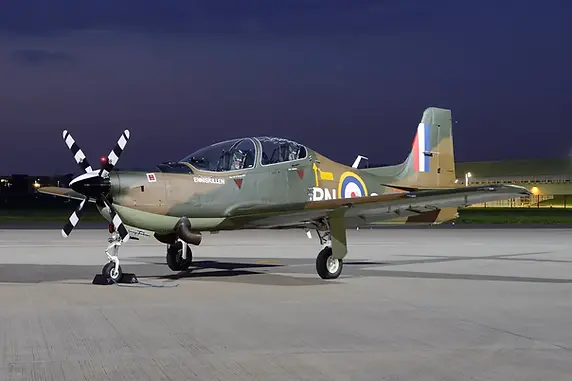
Image: PHIL SMITH
The RAF ordered 130 x Tucano T.1 aircraft, with deliveries commencing in June 1988 and concluding in January 1993. The type served as the RAF's primary basic fast-jet trainer, providing approximately 130 training hours to student pilots before they progressed to the BAe Hawk T.1 for advanced training.
The Tucano T.1 fleet was withdrawn from RAF service on 25 October 2019 after 31 years of distinguished service.
During this extensive operational period, the type compiled a remarkable safety record, with only five aircraft lost in flying accidents and no fatalities – a testament to its robust design and reliability.
The Tucano was replaced by the Beechcraft Texan T.1 (T-6C) as the RAF's basic trainer, with operations centralising at RAF Valley in Wales.

Image: MARK J. CAIRNS
Operational Service History
ZF378 served with 72 (Reserve) Squadron as part of No. 1 Flying Training School at RAF Linton-on-Ouse, North Yorkshire.
During its service life, the aircraft performed basic fast-jet training duties, teaching formation flying, low-level navigation, poor weather flying, and aerobatic handling.
The aircraft initially carried the name "Whizzo" with codes MP-W during the 2007-2009 period before receiving its most famous "Enniskillen" livery.

Image: MARK J. CAIRNS
Special Commemorative Camouflage Livery
In 2017, ZF378 was transformed with a stunning Battle of Britain era camouflage scheme to commemorate the centenary of 72 Squadron, which formed on 2 July 1917.
The special livery replicated the appearance of Spitfire Mk.IIa P7832 "Enniskillen", which served with 72 Squadron during the Second World War.
The aircraft was repainted in authentic Second World War green and brown camouflage with the squadron codes “RN-S” and the name “Enniskillen” prominently displayed.
This tribute held particular resonance as all 130 RAF Tucanos were manufactured by Short Brothers in Belfast, whilst the original Spitfire P7832 had been funded through the Belfast Telegraph Spitfire Fund.
P7832 entered service on 1 January 1941 with No. 6 Maintenance Unit at RAF Brize Norton. After initial processing, the aircraft joined RAF 72 Squadron at RAF Acklington, Northumberland, on 23 April 1941, carrying the codes RN-S.
During its operational career with multiple squadrons, P7832 participated in:
-
Convoy patrol duties (April 1941)
-
Attacks on German battlecruisers Scharnhorst and Gneisenau (December 1941)
-
Operation Jubilee – the Dieppe Raid, flying 29 operational missions (June 1942)
-
D-Day beach patrols and operations during the Normandy campaign (1944)
-
The aircraft also served with RAF 74 Squadron from 9 July 1941, taking part in aerial battles and escort missions.
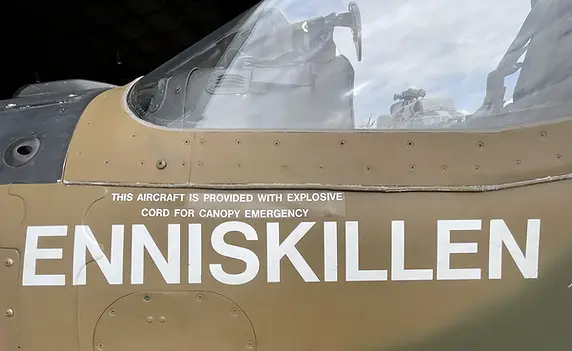
Image: MARK J. CAIRNS
The Original “Enniskillen” Spitfire
The livery honoured Supermarine Spitfire Mk.IIa serial number P7832, one of 17 presentation aircraft purchased through the Belfast Telegraph Spitfire Fund.
Launched on 7 August 1940, the fund raised £88,633 16s 5d from readers across Northern Ireland – enough to purchase 17 Spitfires named after counties, towns, and significant locations.

Image: MARK J. CAIRNS
Significance to NI’s Aviation Heritage
Tucano “Enniskillen” ZF378 represents a unique convergence of Northern Ireland's aviation history:
-
Manufacturing Heritage: Built by Short Brothers in Belfast, demonstrating the company's transition from producing heavy bombers during the Second World War to sophisticated trainer aircraft in the late 20th century.
-
Historical Connection: The “Enniskillen” livery commemorates the Belfast Telegraph Spitfire Fund, which saw ordinary people across Northern Ireland contribute to the war effort, ultimately funding 17 Spitfires... the UAS’ ”Down” Spitfire Replica is also a tribute to them.
-
RAF Training Legacy: As part of 72 Squadron, ZF378 trained the next generation of RAF fast-jet pilots for over 27 years, continuing a tradition of excellence that began with the squadron's Spitfire operations during the Battle of Britain.
-
Living Museum: The aircraft serves as an accessible, tangible connection to both Second World War history and the modern RAF, bridging eight decades of military aviation development.
Photographic study of Tucano ‘Enniskillen’


Manufacturer: Short Bros
Model: Tucano T.1 Fuselage
"Enniskillen" (prev. "Whizzo")
Registration: ZF378 / S121 / T92
Powerplant: Garrett TPE331-12B turboprop
UAS Location: Hangar 2
Production: First Flight on March 1989 then delivered to RAF late April 1989.
Type: Two-seat turboprop basic trainer
Length: 9.86m (32ft 4¼in)
Wingspan: 11.28m (37ft)
Height: 3.40m (11ft 1¾in)
Powerplant: Garrett TPE331-12B turboprop (1,100hp)
Propeller: Four-bladed Hartzell
Ejection Seats: 2 x Martin-Baker MB 8LC
First Flight: 6 February 1992
Delivered to RAF: 26 February 1992
Service Withdrawal: 25 October 2019