


> COLLECTION > AIRCRAFT > HELICOPTERS > Sea King
AIRCRAFT
Fast Jets
Helicopters
Alouette III
Puma HC1
Robinson R-22
Scout
Sycamore
Wessex HC.2
18A Gyroplane
Second World War
Propeller-Driven
Shorts
Vintage
Home-Builds
Special Interest
VEHICLES
SPECIALIST ROOMS

Westland
SEA KING HAS.6
“Lulabelle”

Image: MARK J. CAIRNS
The Royal Navy’s early helicopter years
British armed forces began operating rotary-wing aircraft with a handful of Sikorsky R-4 Hoverfly helicopters supplied under lend-lease during 1944. A batch of fifty-two aircraft began to arrive in the UK in February 1945.
About thirty-six of them were given to the Royal Navy, where sea trials were carried out from HMS Furious, and the type later entered service with 771 Fleet Requirements Unit at Portland in September.
The R-4 was replaced in 1946 by the more powerful R-6A Hoverfly II; and in 1947 the Admiralty encouraged Westland Aircraft Ltd to obtain the right to build Sikorsky S-51s under licence in the UK.

Image: MARK J. CAIRNS
In 1950 the Royal Navy formed what was probably the first all-rotary-wing squadron outside the USA: 705 Naval Air Squadron, operating Westland-built S-51s known as Dragonfly HR.1s, in general utility and rescue roles.
One of the Dragonfly’s most significant moves came in January 1951, when a Dragonfly embarked in the aircraft carrier HMS Indomitable and took over as “plane guard” during flying operations — a duty up until then provided by an accompanying destroyer or a Supermarine Walrus amphibian.
In November 1952 eight Dragonflies took part in a mass formation flypast at Spithead for the new Queen’s Royal Fleet Review.
The Dragonfly was the first of a dynasty of US designs built by Westland, which included the Whirlwind, Wessex and the Sea King.

Image: MOD Crown Copyright
The Sea King enters British service
The Sea King was based on the Sikorsky SH-3D, which first flew in the States in 1959. It came about when Westland reached an agreement, nine years earlier, to produce an “anglicised” version of the Sea King that would meet the UK’s urgent need for a powerful helicopter with long endurance and weapon-carrying capability, to replace the Wessex HAS.3.
Originally the type was to be called the Sea Dragon. Pre-production aircraft were shipped into Avonmouth and transported to Westland’s factory in Somerset.
These pre-production aircraft were fitted with Rolls-Royce Gnome H-1400 series turboshaft engines (General Electric T-58s built under licence), and were delivered to RNAS Culdrose where they were used by 700S Naval Air Squadron, the Royal Navy’s Intensive Flying Training Unit (IFTU). At some point, a decision was made to retain the US name.
Image: MARK J. CAIRNS
In February 1970, 824 Naval Air Squadron (NAS) recommissioned as the UK’s first operational Sea King unit. 824 had a long naval aviation heritage dating back to 1923, when as 423 Flight it operated Avro Bisons on board HMS Argus; early in the Second World War it flew Swordfish from HMS Eagle.
Later, while flying Gannet AS.1s based at Eglinton, it embarked in the new HMS Ark Royal (R09).
Three years later, 824 converted to helicopters, getting Whirlwind HAS.7s and taking them on board for the first time in 1960. Just ten years later, it returned on board Ark Royal with the much more potent Sea King HAS.1s.

Image: MOD Crown Copyright
Sea King XV701: build, delivery and early service
The story of the British ASW Sea King is told perfectly by XV701. She was one of the initial batch of 56 aircraft ordered from Westland Helicopters Ltd in 1966. She first flew at Yeovil on 14 May 1971, and was delivered to RNAS Culdrose a month later.
A standard HAS.1 carried Ecko AW.391 “Blue Orchid” radar, and Plessey Type 195 dipping sonar on the end of a 75 m cable. She had an Advanced Flight Control System (FCS) that allowed the crew to transition into and out from a low hover over the sea at night and in bad weather; and had four weapon-carrying stations, two either side of the fuselage for torpedoes or depth charges; and a capability to carry a WE.177 nuclear depth bomb.
In May 1970, Lt Cdr Vic Sirrett RN flew one of the IFTU’s Sea Kings from Land’s End to John o’Groats, a distance of over 600 nms, non-stop in 4 hrs 20 mins.
XV701 was checked over at the Naval Aircraft Support Unit (NASU), finished with 824 NAS markings and the side number 053, and handed over to 824 NAS in August.
It embarked briefly in HMS Ark Royal on 15 September, then joined the ship for three months of exercises in the North Sea and the Mediterranean before returning home in time for Christmas. By that time XV701 had been joined on board HMS Ark Royal carrier by Phantom FG.1 007 / XT864 (now in the UAS' Heritage collection).
XV701 remained with 824 for the next five years, moving on and off Ark Royal frequently and enjoying at least two trips to the States and operations in the Mediterranean. In March 1974, 809 NAS introduced Buccaneer S2C XV361 into the Carrier Air Group, completing a trio of ex-Ark Royal aircraft now in our collection.
All three may well have appeared in the popular TV documentary Sailor, filmed on board during a 5½ month deployment to the USA and broadcast by the BBC in 1976.

Image: MOD Crown Copyright
XV701 was checked over at the Naval Aircraft Support Unit (NASU), finished with 824 NAS markings and the side number 053, and handed over to 824 NAS in August.
It embarked briefly in HMS Ark Royal on 15 September, then joined the ship for three months of exercises in the North Sea and the Mediterranean before returning home in time for Christmas. By that time XV701 had been joined on board HMS Ark Royal carrier by Phantom FG.1 007 / XT864 (now in the UAS' Heritage collection).
XV701 remained with 824 for the next five years, moving on and off Ark Royal frequently and enjoying at least two trips to the States and operations in the Mediterranean. In March 1974, 809 NAS introduced Buccaneer S.2B XV361 into the Carrier Air Group, completing a trio of ex-Ark Royal aircraft now in our collection.
All three may well have appeared in the popular TV documentary Sailor, filmed on board during a 5½ month deployment to the USA and broadcast by the BBC in 1976.
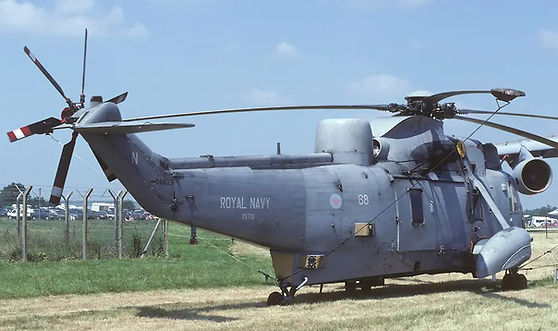
Image: ALEX CHRISTIE
XV701: HAS.2 conversion and the 1979 Accident
In March 1977 XV701 returned to NASU for conversion to HAS.2. The most visible feature of this upgrade was the “barn door”: a large screen in front of the two engine intakes to prevent ice that might form on top of the cockpit from being ingested in the engines; and a sixth blade on the tail rotor to compensate for the additional 320 shaft horse power generated by new 1400-1 version of the Gnome engines. It also had a new transmission system.
In January 1979 she was handed over to 706 NAS with the side number 589. 706 was a training unit based at Culdrose that provided advanced flying training (AFT) to Sea King pilots, observers and aircrewmen before they were sent next door to 810 NAS for their operational flying training (OFT) before finally joining their(front-line units.
Bottom of the deep blue Sea King
In February 1979, during a routine training exercise over Falmouth Bay, practising winching in a 50 ft hover, XV701 suffered a tail rotor gearbox failure, spun out of control, ditched and rolled over.
The seven crew on board were rescued by a safety boat and a Wessex helicopter. An attempt was made to tow the Sea King into Falmouth Harbour, but she sank en route.
The following day she was located and raised by RMAS Pintail, brought into the docks and placed onto a low-loader for transportation to Lee-on-Solent.
After accident investigation, work began on repairs that would take six years. As a result she played no part in the 1982 Falklands Conflict.

Image: TONY SMITH
HAS.5 rebuild and Prestwick years (819 NAS)
XV701 finally emerged in April 1985, having been converted to the latest HAS.5 standard. Trials of the HAS.5 had begun in 1980. Improvements included the MEL Sea Searcher radar, with twice the range of the old kit.
While the aircraft retained the Sonar 195 active tracking system, they now also had a full passive sonar fit, the LAPADS (Lightweight Acoustic Processing and Display System). This (allowed the crew to search for submarine contacts, without the tell-tale “pings” of an active sonar) using networks of passive Sonobuoys dropped in patterns in the water. This could even include Sonobuoys dropped from other supporting aircraft such as RAF Nimrods or other Sea Kings. In addition, the RACAL Orange Crop Electronic Support Measures (ESM) was fitted to detect enemy Radar transmissions.
The most obvious visible clue to a HAS.5 was the larger “drum” radome on top of the fuselage to house the larger Sea Searcher radar scanner. As a rule of thumb, all HAS.5s were painted with black, vice white, markings and lettering, given low-visibility, two-colour tactical roundels.
In August 1985 XV701 was allocated to 819 NAS, based at Prestwick, with side number 706. 819 was another squadron with a long heritage, having been one of the Swordfish units to have flown in the Taranto Raid on the Italian Fleet in 1940.
Now operating from a site on the civilian airport in Ayr, it supported nuclear submarine movements into and out from their base at Faslane, on the Clyde; as well as providing sea and mountain search and rescue cover over the Scottish west coast and the Western Isles.
Hole burned into the rear fuselage
In 1986, XV701 was lent to A&AEE Boscombe Down for weapon trials and during a routine inspection a crack was found in its airframe.
It was sent by road back to Prestwick, but approaching J17 on the M5 the trailer brakes locked on and started a fire which burnt a large hole in the rear fuselage.
It arrived at Prestwick six days later and went straight into the hangar for further repairs, returning to 819’s flight line by May 1987.

Image: MARK J. CAIRNS
HAS.6 conversion and return to the front line

In the late 1980s there was a fork in development of the HAS.5. Some would soon have an enhanced ASW fit as a HAS.6, while others would have kit removed and then be dedicated to SAR as the HU.5. XV701 was destined to be converted to HAS.6.
In 1987, it was repainted with the new-look light grey scheme, spent a short while with 810 NAS, then went into RNAY Fleetlands for her last major update.
The HAS.6 had further operational enhancements: composite rotor blades and a new active dipping Sonar, the Thompson Marconi 2069 with a much longer cable on the dipping sonar (213 m). Orange Reaper ESM replaced Orange Crop, and the avionics and sensor processing software were updated. The all-up-weight (AUW) of the helicopter was reduced, producing a beneficial increase of 30 mins to its on-task time.
Image: MARK J. CAIRNS
Then by March 1990, XV701 was allocated to 820 NAS, given side number 010 and the nickname “Starbugs 2”. 820 NAS had been attached to HMS Ark Royal (R07) since 1986, but enjoyed an older connection with previous ships of that name.
Almost 50 years earlier, in 1939, its Fairey Swordfish were the first aircraft to land on the second Ark Royal.
In March 1990 they embarked with new Sea King HAS.6s on the fourth as it sailed for exercises, then crossed the Atlantic for a “Westlant” deployment to the States and Caribbean.

Image: ALAN JARDEN
Early in 1991 Ark Royal, with 820 embarked, sailed for the Eastern Mediterranean to join other allied warships operating in the area, in what would later be called “Gulf War 1”.
Historian David Hobbs writes that no British aircraft carriers took a direct part in the conflict. He explains that Navy Command saw little point in deploying a carrier force as there were already sufficient combat aircraft in theatre and that Ark Royal would be used as a command ship.
Hobbs also points to political indecision and arguments that resurfaced about the ship’s purpose; however, Ark Royal led Task Group 323.2, which included the frigates HMS Sheffield and HMS Charybdis together with the RFAs Olmeda and Regent, and worked closely with USS Virginia, USS Philippine Sea and USS Spruance, in the USN Sixth Fleet.
In the event it was not required to take action, but she did spend fifty-one days at sea at a high degree of readiness before returning to the UK in April.
Over the next five years, 820 NAS remained attached to HMS Ark Royal before moving to her sister ship HMS Illustrious.

Image: ALAN JARDEN
814 NAS, HMS Invincible, and final deployments
In 1996, Sea King XV701 left 820 and joined 814 NAS on board HMS Invincible. It was given side number 268 and the new nickname “Lulabelle”, flying with the squadron on two major exercises, and the year ended with them in the Persian Gulf operating with USS Enterprise.
For most of 1997 Invincible worked on integrating RAF Harrier GR.7s with the Royal Navy’s Sea Harrier FA.2s, while most of 814’s helicopters operated from the flight deck of RFA Fort Victoria, an accompanying stores ship.
As Christmas approached, a voyage home was cancelled and Invincible was dispatched to the Eastern Mediterranean, at short notice to sail through the Suez Canal for operations against Iraq.
Relieved by HMS Illustrious in April 1998, Invincible was back in the Persian Gulf again from January–April 1999.

Image: ALAN JARDEN
Withdrawal from service and preservation
XV701 remained with 814 NAS until the end of 2000, when the squadron disbanded. The ASW Sea Kings were being withdrawn from service and replaced by Merlin HM.1s.
XV701 was placed in long-term storage at HMS Sultan in Gosport and, from 2001, used primarily for ground instruction, moving between Sultan and RAF Cosford.
XV701 had been stored at HMS Sultan since 2015 and was one of several airframes offered to suitable aviation collections, including the Ulster Aviation Society.
Sea Kings remained in service until 2018, with Commando, Airborne Early Warning and Search & Rescue squadrons — by which time it had become one of, if not the longest, serving aircraft types to have served with the Royal Navy.

Image: MARK J. CAIRNS
XV701 History research text written by Tim Brown
Additional research by Chris Morshead